How an LLM Brought My Wall Tablets Back to Life
Six years ago I yanked my ADT panels off the walls and replaced them with Amazon Fire tablets running custom dashboards. When the dashboard service quietly shut down, my tablets became useless screensavers — until I sat down with an LLM.

Six years ago I ripped my ADT alarm panels off the walls and replaced them with Amazon Fire tablets running smart-home dashboards. Last November the dashboard service vanished overnight, and my tablets became useless screensavers. A couple of hours with an LLM later, I had a custom dashboard better than the one I'd been paying for — and a clearer sense of what AI is genuinely good for.
Backing up a step: the old 5V alarm wire from those ADT panels became my new 24/7 power supply, and a small company called Konnected turned out to be the missing bridge — their hardware lets you take an old wired alarm system and feed all those door contacts and motion sensors straight into a modern smart home setup.
For years, ActionTiles handled the dashboard layer on those tablets. Tap a button, the kitchen lights came on. Tap another, the pool vacuum started. Music in any room. It was great.
Then ActionTiles disappeared.
The Tablets Become Screensavers
Late last year — November 2025 — the company quietly went dark. The domain went away. My dashboards stopped working. Overnight, my wall tablets became useless screensavers. I kept meaning to fix it. I never did. They sat there for months, glowing softly, mocking me from every wall in my house.
A few weekends ago I decided to see what a modern LLM could do with the problem.
What I Asked It To Build
I gave the LLM the constraint set: fixed-resolution wall tablets, Home Assistant as the source of truth, Hubitat behind that for the Z-Wave devices, real rooms with real residents, and a strong preference for "press a button, light goes on, no surprises."
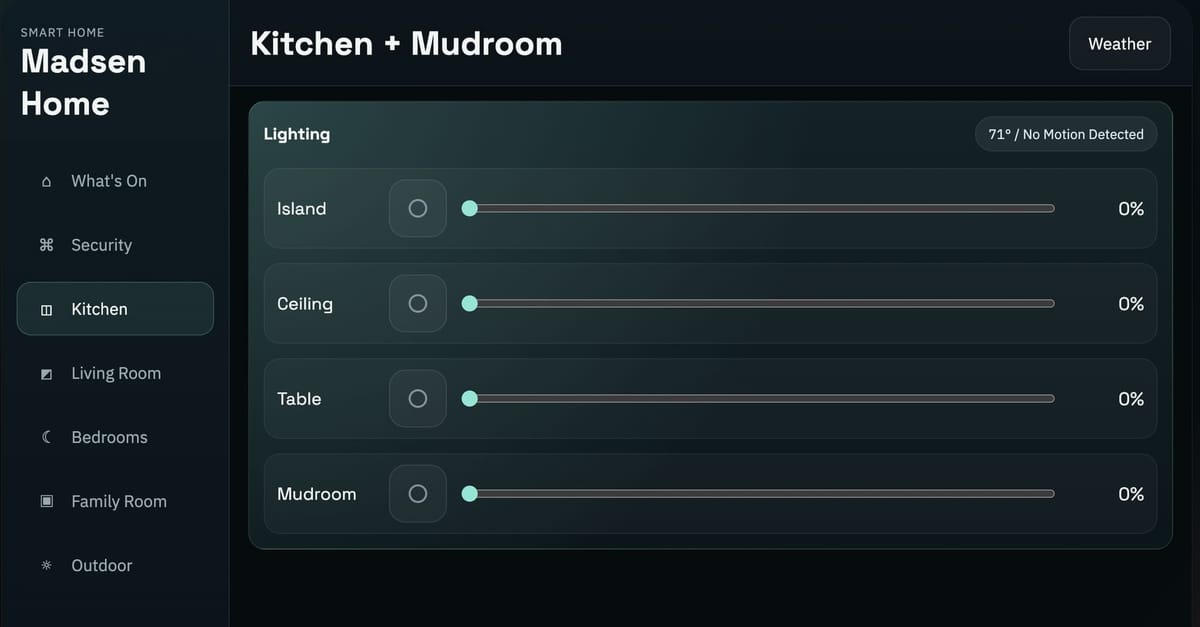
We built it. A real Python backend running as a systemd service on my home server (his name is Roger, naturally). A clean "What's On" landing screen — just lights on and locks open, both clickable to drill in. Live five-day weather pulled straight from Home Assistant's forecast service. Sliders that don't snap back when you drag them. Bedroom names that finally match the kids actually living in them.
The Part I Didn't Expect
Two things surprised me along the way.
First, the dashboard itself was the easy part. The hard part was getting the screen to honestly show what's happening when devices take a few seconds to actually respond. On a tablet the whole family sees every day, a light that "might be on, we're not sure" is worse than no dashboard at all.
Second, the LLM didn't just write the dashboard. It dug into the rest of my smart home — diagnosing network health, cleaning up labels at the source, and even mapping out a path forward for the blinds I'd long given up on. It could reason across the whole system, not just the screen in front of it. That's a very different kind of useful than "write me some HTML."
Bridging Digital to Physical
Some people worry about LLMs replacing them. I see it as the opposite — a genuinely exciting opportunity. Before, I had to pay for a service (ActionTiles) and ended up with a not-so-great dashboard. Now, with a little tinkering, I've got a custom-built one that looks fantastic and does exactly what my house actually needs.
ActionTiles' shutdown wasn't really a software problem; it was a motivation problem. Rebuilding from scratch felt like a weekend I didn't have. With an LLM in the loop, the cost of "let me try" dropped to almost nothing.
The tablets are alive again. The mesh is faster. The kids' rooms have the right names. And the bridge from digital (a button on a screen) to physical (the pool vacuum kicks on, the lights dim for movie night) feels closer than ever.
Still on the list: actually getting the Levolor blinds in. That one's going to need new hardware. But that's a problem for next weekend.